

Makar Sankranti 2027: reference dates
Washington, D.C., United States: January 14, 2027.
Reference timezone: America/New_York / U.S. Eastern Time.
New Delhi, India: January 15, 2027.
High confidence · location-sensitive
These are location-sensitive reference dates, not one worldwide ritual date. Local civil time and observance rules matter. Confirm locally before planning worship.
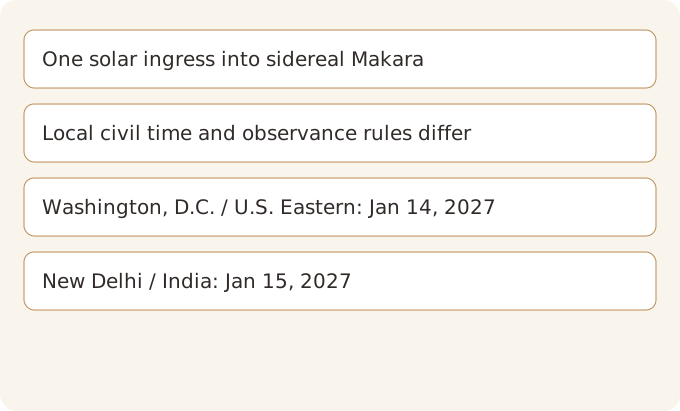
- One solar ingress into sidereal Makara
- Local civil time and observance rules differ
- Washington, D.C. / U.S. Eastern: Jan 14, 2027
- New Delhi / India: Jan 15, 2027
One astronomical instant can lead to different local observance dates. This diagram shows observance dates, not muhurta timings. Sources: Drik Panchang location calculations, cited below.
Use the 2027 Festival Calendar for the wider reference set and its location, tradition, and source-variation notes.
Name, sidereal ingress, and Uttarayana
In this zodiacal context, Makara means Capricorn; saṃkrānti means passage or transition, including entry into a zodiacal sign. Makar Sankranti follows the Sun’s sidereal entry into Makara. Its date changes less than lunar festivals, but is not permanently fixed.
The traditional association with Uttarayana, the Sun’s northward course, remains important. In modern seasonal astronomy, the northward turn occurs at the December winter solstice. Precession has gradually separated that seasonal marker from sidereal Makara ingress. Traditional festival naming and astronomical reference frames should be distinguished respectfully.
Related seasonal celebrations, distinct traditions
Pongal is a Tamil harvest festival complex, not simply another name for one identical ritual. Lohri belongs to the Punjabi mid-January seasonal context and is associated with the eve of Maghi/Sankranti. Assam’s Magh or Bhogali Bihu has its own harvest and community traditions. Gujarati Uttarayan is especially closely identified with Sankranti and kite celebration.
Makar Sankranti is a solar Hindu observance that overlaps with regional harvest seasons. Hindu American Foundation describes Surya-related devotion; BAPS documents charity in Gujarati/Swaminarayan practice. West Bengal tourism documents sacred bathing and pilgrimage at Gangasagar. These are particular contexts, not requirements for every Hindu.
Key takeaways
- Unlike many lunar festivals, Makar Sankranti is tied to a solar transition and usually falls around January 14–15, rather than permanently on January 14.
- Gujarati Uttarayan is closely identified with Sankranti; concurrent regional festivals such as Magh Bihu have distinct identities.
- Pongal is a major Tamil harvest festival with its own multi-day guide, not merely another label.
A solar marker
Sankranti names a solar transition; Makara corresponds to Capricorn in the sidereal zodiac. Calendrical systems and popular explanations of Uttarayana should be distinguished from the astronomical winter solstice.
Surya and sacred bathing
Worship of Surya, river bathing, pilgrimage, charity, and offerings appear in several regions. Major gatherings can be associated with the Ganga and other sacred waters. Local ritual rules require local sources.
Food, gifts, and harvest
Sesame, jaggery, rice, pulses, sugarcane, and newly harvested foods appear in regional dishes. Gift exchange and speech about warmth or reconciliation are prominent in some communities. Food customs are not universal.
Kites and public celebration
Uttarayan kite festivals are especially visible in Gujarat and elsewhere. Safe participation requires clear rooftops, child supervision, awareness of birds, and avoidance of dangerous line materials.
Regional names
Magh Bihu in Assam, Poush Sankranti in Bengal, Khichdi traditions in North India, Sankranti celebrations in Andhra Pradesh and Telangana, and other regional observances have distinct calendars and practices. They should not be collapsed into one list of “Indian customs.”
Family learning
Compare how one seasonal transition is marked through sun, food, animals, river, field, kite, or community. Let the regional source speak first.
Sources and further study
Sources for this guide
- Drik Panchang, 2027 Hindu Calendar. Washington, D.C. reference; select the stated location when consulting the source. New Delhi Makar Sankranti calculation.
- Positional Astronomy Centre / IMD, Rashtriya Panchang. Sidereal solar transits and calendrical methodology.
- Nachum Dershowitz and Edward M. Reingold. “The Modern Hindu Calendars”. Calendrical Calculations, Cambridge University Press, 2007, 275–314.
- Hindu American Foundation, “Makar Sankranti”; BAPS, “Uttarayan”. Living practice, with regional/tradition limits.
- Assam Tourism, “Bihu Festival”; Gujarat Tourism, “International Kite Festival”; Gangasagar Mela, government tourism resource. Regional practice.
- Monier Monier-Williams. A Sanskrit-English Dictionary, Oxford, 1899, “makara” and “saṃkrānti.”
- Date sourceSupreme Court of India. Calendar 2026; confirm local calendars and temple schedules.
- Government contextPresident of India. Greetings for Lohri, Makar Sankranti, Pongal, and Magh Bihu, January 12, 2026.
- ScholarshipAxel Michaels. Hinduism: Past and Present. Princeton University Press, 2004.
- ScholarshipJulius J. Lipner. Hindus: Their Religious Beliefs and Practices, 2nd ed. Routledge, 2010.