Om
A sacred syllable and sound interpreted through Vedic, Upanishadic, devotional, and yogic traditions.
Not a generic wellness logo or one fixed English definition.

Hindi, Gujarati, Tamil, Telugu, and Bengali editions are planned. Browser translation can help temporarily, but it is not equivalent to an editorial translation.
View language roadmapA visual museum and learning explorer
Explore sacred forms, ritual objects, marks, sounds, and visual traditions found across Hindu life. Meanings and uses may differ by region, community, text, and tradition.
Symbols Explorer
The original drawings below are educational illustrations. Sacred forms appear only in their relevant guides and explorer cards—not as unrelated site decoration.
12 symbols
A sacred syllable and sound interpreted through Vedic, Upanishadic, devotional, and yogic traditions.
Not a generic wellness logo or one fixed English definition.
A flower associated with beauty, emergence, purity, divine presence, and several deities.
Meanings depend on the deity, text, image, and ritual setting.
A small lamp used in worship, festivals, welcome, remembrance, and household practice.
Fire requires adult supervision; meanings vary by setting.
Forehead marks whose materials, forms, meanings, and wearers differ by tradition, occasion, region, and family.
Tilak, bindi, tripundra, and urdhva pundra are related terms, not interchangeable labels.

An ancient auspicious sign whose Hindu uses must be explained alongside the Nazi emblem’s modern history and harm.
Context is essential; this symbol is never used as general site decoration.
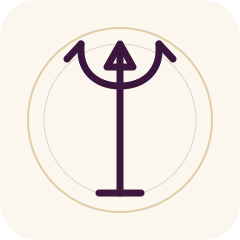
A three-pronged emblem especially associated with Shiva and with goddess traditions in particular contexts.
Interpretations of the three points vary and should be labeled.
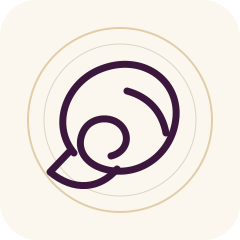
A conch shell sounded in ritual and represented as an attribute of Vishnu and related forms.
Actual use, direction, and ritual handling vary.
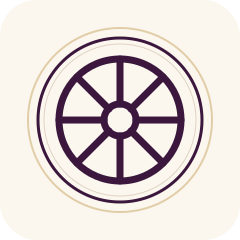
A wheel or discus with several meanings; as Sudarshana Chakra it is a defining attribute of Vishnu.
Do not confuse deity iconography with every yogic use of the word chakra.

A central aniconic or non-figural form of Shiva worship with layered theological, ritual, and generative meanings.
Reducing the form to one sexual explanation is inadequate and often misleading.
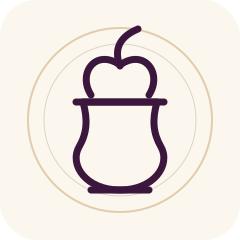
A prepared vessel used to represent abundance, welcome, presence, water, fertility, or a ritual center.
Contents and ritual interpretation differ by ceremony and region.
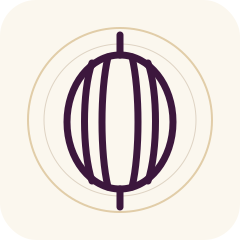
A seed used as a devotional bead and especially associated with Shiva and recitation practice.
Commercial claims about guaranteed powers require skepticism.
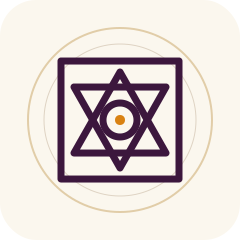
A consecrated geometric diagram used in particular ritual and contemplative traditions.
A yantra is not simply decorative geometry; construction and use can be lineage-specific.
No symbols match these filters. Clear a filter or browse the alphabetical list.
How to use this section
Begin with the object or mark, then ask which deity, text, ritual, region, and community explain it. A symbol can move between art, worship, household practice, and public identity without carrying exactly the same emphasis.
Start with Om, then connect sound to mantra, recitation, and Upanishadic interpretation.
Understand lamps, vessels, conches, and beads through the practice that prepares and uses them.
Compare marks, flowers, weapons, and emblems without assuming one visual form has one meaning.
These pages need especially careful context because ritual use, public display, and modern associations can differ sharply.