
Two meanings to keep separate: saṃskāra has uses beyond life-cycle ritual in Indian religious and philosophical vocabularies. This page is specifically about rites of passage and domestic/life-cycle ritual.
What is a samskara?
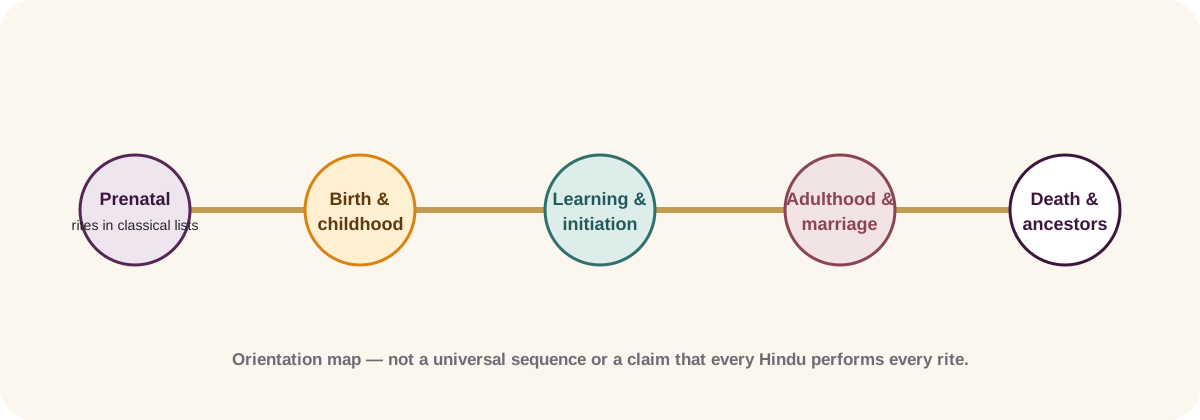
Axel Michaels’ chapter on saṃskāra in The Oxford History of Hinduism: Hindu Law treats the category historically through Gṛhyasūtras and Dharma texts and follows rites across prenatal life, birth and childhood, initiation, marriage, old age, death, and ancestors. That scope is more useful than the popular idea that “samskara” simply means one ceremony or one universal checklist.
Life-cycle rites can mark a change in status, responsibility, kinship, learning, household life, or relationship to ancestors. Their ritual forms, eligibility rules, meanings, and modern importance vary by source and community.
Are there always sixteen samskaras?
No. “The sixteen samskaras” is an influential organizing idea, but historical lists and counts vary. A university e-PG Pathshala/INFLIBNET module explicitly notes that some classical sources speak of other counts while presenting one traditional sixteen-rite scheme. That is useful evidence for the importance of sixteen as a teaching framework—and equally useful evidence that the framework should not be universalized.
Modern lists also differ in which rites are counted separately. One list may include a first-outing rite or ear-piercing where another counts several Vedic student vows, for example. Hinduism Insights therefore organizes the topic by life stage first, then names examples with their source context.
Life-stage map
| Stage | Examples found in classical/educational lists | What to remember |
|---|---|---|
| Before birth | Garbhādhāna, puṃsavana, sīmantonnayana / sīmanta | Classical prescriptions can reflect historical assumptions about reproduction, gender, lineage, and ritual eligibility that should not be presented as universal modern rules. |
| Birth & childhood | Jātakarma, nāmakaraṇa, annaprāśana, cūḍākaraṇa/caula; other lists may include additional childhood rites | Naming, first food, hair-cutting, and other milestones may survive, adapt, combine, or disappear in different families. |
| Learning & initiation | Upanayana and, in some schemes, Vedic student vows and completion rites | Historically, initiation and Vedic eligibility were tied to social and gender restrictions in important sources; contemporary practice is not uniform. |
| Marriage / householder life | Vivāha and related transitions into household life | Marriage is not one universal Hindu ceremony; languages, ritual manuals, kinship customs, and regional traditions differ. |
| Death & ancestors | Antyeṣṭi/aparakarma and ancestor-related ritual contexts | Death ritual is especially community- and family-specific; a general education site should not substitute for local ritual guidance. |
Upanayana as a case study in continuity and change
Upanayana is a useful example because it appears in classical discussions of student initiation and remains a living rite in some communities. Timothy Lubin’s work on the Vedic student situates the rite within historical systems of Vedic education and social eligibility. The Harvard Pluralism Project’s modern educational description, by contrast, presents a contemporary family/community setting where the rite marks a serious relationship to sacred learning rather than literally sending a child away to an ancient student life.
Those two lenses—historical source and contemporary example—should not be collapsed into one timeless definition. They show how a rite can persist while its social setting and interpretation change.
Historical restrictions need to be named, not erased
Some Dharma and Gṛhya textual traditions restrict Vedic rites by varna and gender and describe goals that modern readers may find ethically difficult. A source-led educational page should neither present those restrictions as commands for all Hindus today nor hide them to create a falsely timeless picture. They are part of the history of the category.
Contemporary Hindu communities may preserve, broaden, reinterpret, combine, or omit rites. Practice can also change through migration, interregional marriage, temple/community institutions, and family choice.
What a general guide should not do
- Publish one “correct 16” list as though every source agrees.
- Turn a descriptive historical rite into medical, fertility, or gender advice.
- Give mantras or procedural instructions outside a verified tradition-specific source and context.
- Assume a rite performed in one Brahmanical textual tradition describes all Hindu communities.
- Tell a family that an omitted rite makes their Hindu identity incomplete.
How samskaras connect to the rest of Hindu life
Life-cycle rites often connect with puja, family deities, fire ritual, gifts, vows, teachers, kinship, sacred time, food, and ancestor memory. Their meaning is therefore not only “ceremonial.” They can mark who is learning, who belongs to a household, what responsibilities are changing, and how a family interprets a life transition.
For families
Use this guide to identify the kind of rite you are asking about, then turn to the family, priest, teacher, temple, or community that actually carries the relevant tradition.
For students
Distinguish historical prescription, scholarly description, and present-day practice. They answer different questions.
Sources and further study
- Axel Michaels, “Rites of Passage: saṃskāra,” in The Oxford History of Hinduism: Hindu Law (2017), pp. 86–97. Oxford Academic.
- Axel Michaels, “Individualized and Domestic Rituals (saṃskāra),” in Homo Ritualis (2016). Oxford Academic.
- Timothy Lubin, “The Vedic Student: brahmacārin,” in The Oxford History of Hinduism: Hindu Law (2017). Oxford Academic.
- Korada Subrahmanyam, “Sixteen Saṃskāras (Ṣoḍaśasaṃskārāḥ),” e-PG Pathshala / INFLIBNET. INFLIBNET. Used as one traditional/educational list, not a universal modern standard.
- Harvard Pluralism Project, “Upanayana: The Sacred Thread.” Pluralism Project. Used as a scoped contemporary example.