
What does prasad mean in English?
Common English renderings of prasāda include grace, favor, and blessing; the word can also express clarity or serenity. In worship, prasad is an offering subsequently received as a blessing. “Blessed food” describes a common use, but not the whole Sanskrit meaning. Prasad, prasāda, and prasadam are related spelling and usage forms, not separate religious categories.
In Bhagavad Gita 2.64, prasāda concerns serenity or self-poise rather than ritual food. Gita 9.26 describes devotional offering; it is neither a lexical definition of prasad nor a complete ritual procedure.
Naivedya and receiving prasāda
In many contexts, naivedya refers to food presented to a deity during puja, while prasāda refers to what devotees subsequently receive. Bhog/bhoga can also name offerings in particular settings. Terminology and ritual sequencing vary by tradition. Receiving and sharing can express grace, devotion, and community; there is no single explanation binding every temple or household.
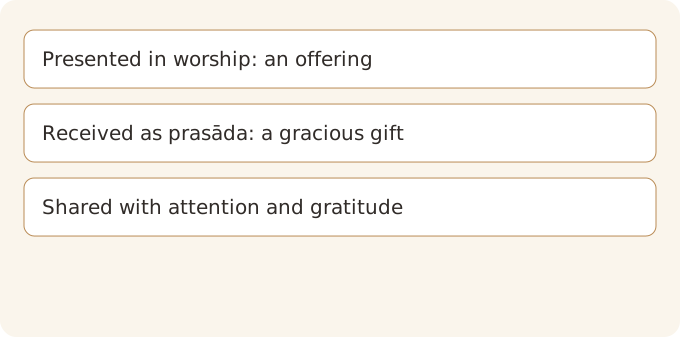
- Presented in worship: an offering
- Received as prasāda: a gracious gift
- Shared with attention and gratitude
A common explanatory pattern, not a universal ritual sequence. Terminology and practice vary. Source: Andrea Marion Pinkney (2013), cited below.
Key takeaways
- Prasad is not simply a free snack after worship.
- Receiving and sharing express relationship, grace, and community in different ways.
- Allergies, hygiene, dietary needs, and consent remain important.
Offering and return
Food placed before a deity may be offered through prayer, gesture, mantra, or a temple rite. It returns to devotees with a changed relational status: it has been presented and received. Traditions explain divine participation differently, so “the god eats it” is too crude as a universal description.
What prasad can be
Fruit, sweets, cooked rice, water, milk preparations, leaves, nuts, sugar crystals, or a full meal may be distributed. In some settings, flowers, ash, sandal paste, sacred water, or other blessed substances are also called prasad. Ingredient rules depend on the deity and institution.
Receiving respectfully
Watch local practice. Prasad may be placed into cupped hands, received with the right hand, consumed nearby, or taken home. Do not put it on an unclean surface. If you cannot consume it, ask quietly what to do. A respectful refusal for allergy, health, or conscience is better than accepting and discarding carelessly.
Temple kitchens and shared meals
Large institutions may prepare enormous quantities under detailed purity, safety, and service systems. Community meals can express hospitality and equality, but their theology and organization differ. Prasad at one temple should not be used as a template for another.
Food safety and access
Blessed status does not remove allergy or contamination risk. Ask about nuts, dairy, gluten, sweeteners, and shared equipment. Parents should assess choking risks. People managing diabetes or other conditions can seek a symbolic or small portion if local practice allows.
More than food
The wider Sanskrit term can suggest graciousness, favor, clarity, or peace. In devotional life, prasad can direct attention away from ownership: what is prepared is offered, and what returns is received with gratitude rather than treated as purely private consumption.
Sources and further study
Sources for this guide
- Andrea Marion Pinkney. Prasāda, the Gracious Gift, in Contemporary and Classical South Asia. Journal of the American Academy of Religion 81(3), 2013, 734–756. Scholarship on offering, receiving, and varied practice.
- IIT Kanpur, Gita Supersite. Bhagavad Gita 2.64 (semantic context) and 9.26 (devotional offering); no translation reproduced.
- Ritual ethnographyC. J. Fuller. The Camphor Flame, rev. ed. Princeton University Press, 2004, discussions of offerings and divine service.
- Temple food studyR. S. Khare. The Eternal Food: Gastronomic Ideas and Experiences of Hindus and Buddhists. State University of New York Press, 1992.
- ReferenceMonier Monier-Williams. A Sanskrit-English Dictionary, entry “prasāda.” Oxford, 1899; public-domain lexical reference.
- ScholarshipAxel Michaels. Hinduism: Past and Present. Princeton University Press, 2004.