
Is there one Hindu calendar?
No single calendar system is used identically by every Hindu community. Oxford’s survey of Hindu calendrical traditions describes a traditional lunisolar landscape with significant regional variation; at Indian independence, numerous calendar systems were in use. India’s official Rashtriya Panchang was later developed in part to standardize astronomical/calendar information for national purposes, not to erase every living religious convention.
For a reader, the practical lesson is simple: first identify which calendrical convention and location a date is using. A date without that context can look more universal than it really is.
What is a panchanga?
Pañcāṅga literally points to a five-part almanac framework. The India Meteorological Department’s Rashtriya Panchang lists the familiar five elements as vāra (weekday), tithi, nakshatra, yoga, and karana, alongside sunrise, sunset, Moon and Sun information and other astronomical data.
| Element | Beginner orientation | Why it matters |
|---|---|---|
| Vāra | Weekday | Places the almanac in the civil week. |
| Tithi | Lunar-day unit defined by Moon–Sun angular separation | Many festivals and vratas are tied to a particular tithi. |
| Nakshatra | A lunar mansion / segment used to describe the Moon’s position | Used in many calendrical and ritual contexts. |
| Yoga | A calculated Sun–Moon combination | One of the classical five panchanga elements. |
| Karana | Half-tithi unit | Adds finer calendrical subdivision. |
A tithi is not a fixed 24-hour day
The Rashtriya Panchang defines a tithi by the Moon gaining 12 degrees of longitude relative to the Sun. That is an astronomical relationship, not a midnight-to-midnight civil date. A tithi can therefore begin or end at a clock time that falls inside a civil day.
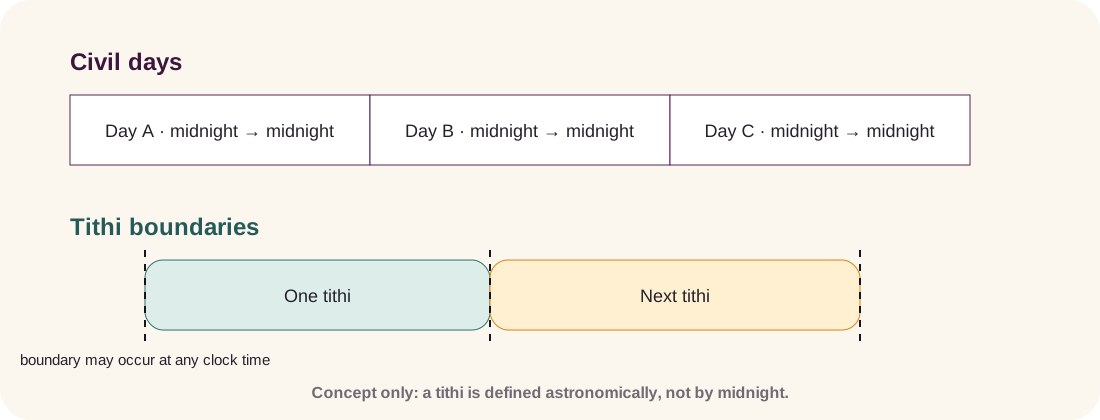
Conceptual diagram only. It does not calculate a real tithi.
This is one reason a festival rule may need more than “the tithi occurs on Tuesday.” A tradition may care which tithi is present at sunrise, at night, or during another ritual window. Different observances use different rules.
Shukla paksha and Krishna paksha
A lunar month is divided into two fortnights. Shukla paksha is the waxing or bright fortnight leading toward full moon; Krishna paksha is the waning or dark fortnight leading toward new moon. Each paksha contains fifteen tithi positions in the standard thirty-tithi structure.
These labels are descriptive calendrical terms. They should not be turned into a universal rule that every bright-fortnight day is spiritually “good” and every dark-fortnight day is “bad.”
Why one lunar month can have two names in different calendars
Two major month-boundary conventions are commonly called Amanta and Purnimanta. In an Amanta reckoning the lunar month ends at new moon; in a Purnimanta reckoning it ends at full moon. A historical reference, Sewell and Dikshit’s The Indian Calendar, explicitly tabulates the correspondence between the two systems.
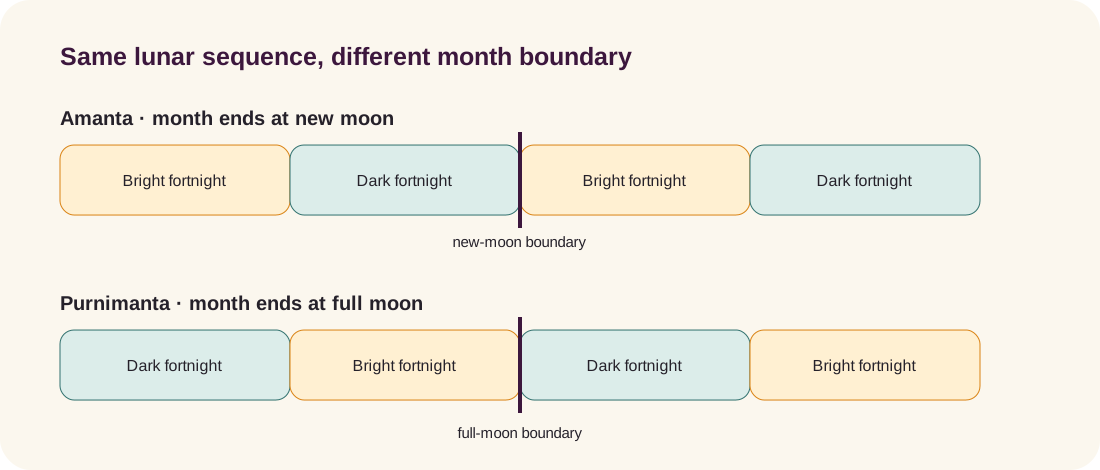
The key beginner insight is that the same astronomical day can carry a different lunar-month label depending on the convention. That does not automatically mean two almanacs disagree about the sky.
What is adhika masa?
A twelve-month lunar year is shorter than a solar year. Oxford’s Hindu calendar bibliography notes that traditional lunisolar systems periodically insert an additional month—adhika māsa—to keep lunar reckoning aligned with the solar/seasonal cycle. The exact calendrical determination is a technical subject; Hinduism Insights does not attempt to calculate an intercalary month from scratch on this page.
Not every regional calendar is organized the same way
Some Hindu calendrical traditions emphasize lunar months; others use solar months for important regional calendars while still using tithi and other lunar information for many observances. New-year boundaries, month names, eras, and festival rules can therefore differ even when communities share much of the same astronomical vocabulary.
That is why this site avoids phrases such as “the exact Hindu date worldwide” unless the claim is truly location- and tradition-independent.
Why location can move a festival by one civil day
Astronomical moments can be converted to local civil time, while sunrise and other ritual windows occur at different local times. When an observance rule asks which tithi is present during a specific local window, two cities can land on different civil dates.
For example, the parent-validated 2027 calendar on this site uses Washington, D.C. / U.S. Eastern Time as its primary reference. It shows Rama Navami on April 14, 2027 for that reference while a New Delhi calculation falls on April 15. The point is not that one country has the “real” festival and the other is wrong; the point is that the calendrical rule is being applied to different local times.
How Hinduism Insights handles festival dates
- State a reference location and timezone.
- Use a location-specific specialist panchang calculation appropriate to the observance.
- Cross-check India-oriented calculations where a one-day difference is material.
- Use government/technical panchang sources for astronomical methodology.
- Show a variation note rather than hiding disagreement.
- Tell readers to confirm ritual observance locally.
Reference used by the 2027 calendar: Washington, D.C., United States · America/New_York. See all 24 validated 2027 records.
Sources and further study
- India Meteorological Department, Positional Astronomy Centre, Rashtriya Panchang: explanation of panchanga elements and astronomical calculations.
- Klaus Klostermaier, “Calendar,” Oxford Bibliographies in Hinduism (2015). Oxford Academic.
- Robert Sewell and Shankar Balakrishna Dikshit, The Indian Calendar, historical reference. IGNCA scan.
- For Hinduism Insights’ date-source hierarchy and editorial boundaries, see Sources & Methodology.